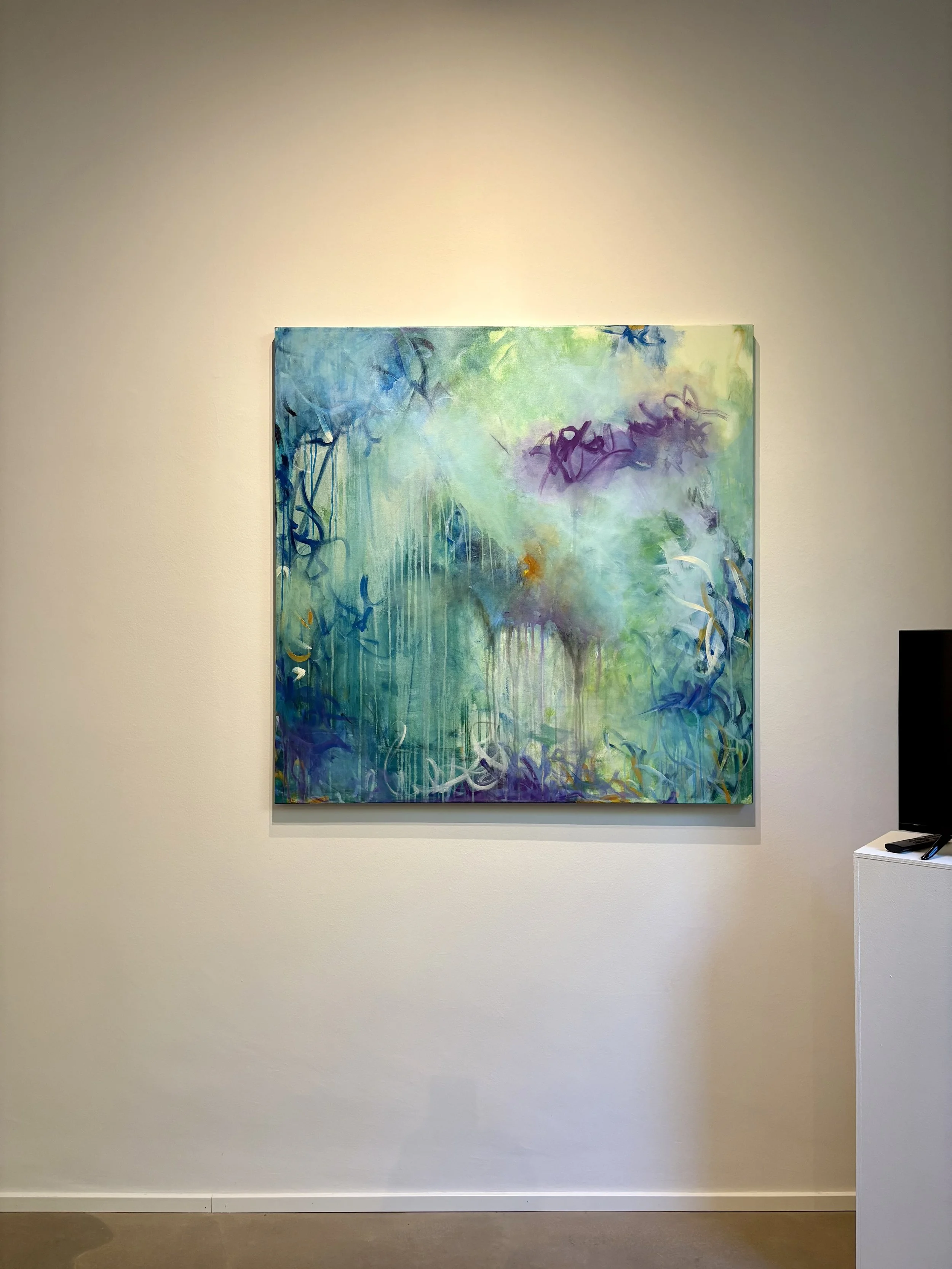
Lines of Memory and Places of the Soul: Mehrnoush Elahipanah Between Heritage and Transformation
Critical essay by Claudia CortiThere is an invisible line in the works of Mehrnoush Elahipanah, not a sharp boundary, but a precise moment when the mark on the pictorial surface stops being merely a technical gesture and becomes something else. It is there that the noble and ancient art of Persian calligraphy, in her hand, breaks free from the function of writing to transform into a landscape of memory. Her lines do not tell a story; they evoke memories, bending, thinning, and breaking as if they had traveled through time and bore its traces. Every stroke seems to arise from a silent reworking of her own life experience: remembering without explaining.
The mark on the canvas, therefore, becomes a place—not a physical space, but an interior geography where traces of a childhood lived in Iran are deposited, a country overwhelmed in the early 1980s by a radical change, where words like "tradition" or "belonging" suddenly became stained with negative nuances and took on the contours of conflicts and wars. There is no explicit nostalgia, but a constant presence of the past, like a subtle stratification surfacing beneath the layer of the paper or canvas. Looking at her works, one gets the feeling that something has been written and then partially forgotten, and that its strength lies precisely in that forgetting.
The line, often, never truly closes; it remains suspended, like a sentence left half-finished, or like a memory that refuses to be completely grasped. It is in this incompleteness that a space opens up for the viewer: an invitation to enter, to fill in, to lose oneself. It is not a matter of reading, but of passing through. Mehrnoush Elahipanah works on the margin between the visible and the invisible, between language and silence. Her works do not need to be deciphered or explained, but simply listened to. And in that slow, attentive listening, one discovers that every mark is memory—not only of the artist, but of anyone who has ever tried to hold onto something that inevitably slips away.
Born in Tehran in 1981 into a multicultural family with Kurdish, Armenian, and Persian roots, Mehrnoush Elahipanah lived through the Iran-Iraq war in the extremely complex context of post-revolutionary Iran, where her initial artistic training took place, later completed in Azerbaijan and finally in Milan. It is probably due to this multiplicity of cultures and views that speaking of her relationship with art history means moving on a terrain made more of resonances than direct citations. Her work does not replicate the past; it absorbs it, passes through it, and transforms it into a personal language in which the great predecessors re-emerge as subtle signatures.
The first dialogue, inevitable, is with the tradition of Persian calligraphy, in which the mark is discipline, rhythm, and measure; it is an art that tends toward harmony and formal perfection. Elahipanah starts from there, but she cracks that balance: where the masters sought continuity and clarity, she introduces interruptions and fragility. It is as if calligraphy, in her works, preserved the memory of its origin but was traversed by a contemporary condition made of changes, loss, and new research.